
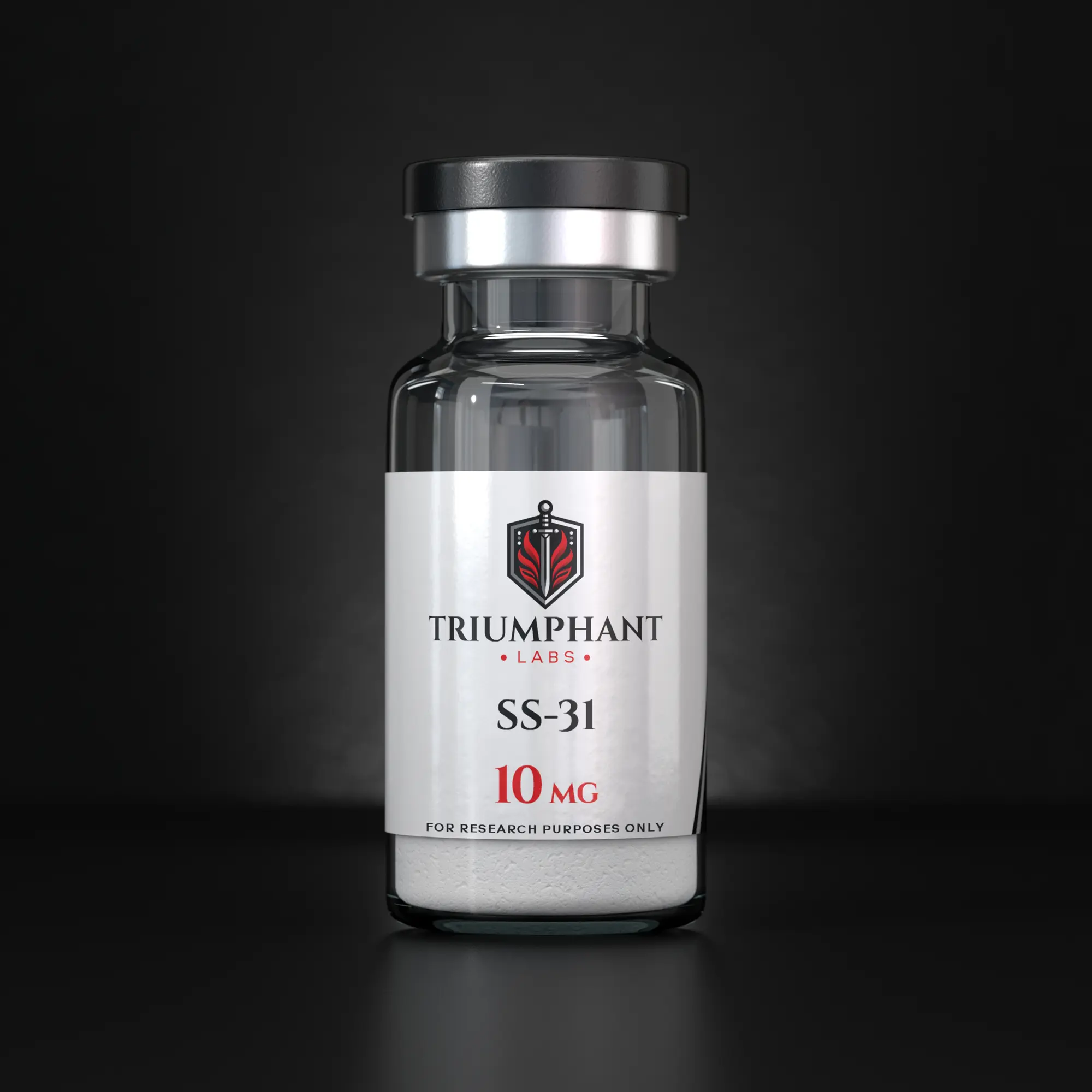
SS-31
$64.00
SS-31, also known as Elamipretide, is a synthetic mitochondria-targeted peptide with a compelling and rapidly expanding research profile centered on mitochondrial membrane protection, oxidative stress reduction, and cellular energy optimization. This research-grade formulation has attracted significant scientific interest among researchers exploring mitochondrial dysfunction, cardioprotection, age-related cellular decline, and the emerging field of mitochondria-targeted therapeutic peptides.
SS-31, scientifically designated as Elamipretide and belonging to the Szeto-Schiller peptide family, is a synthetic tetrapeptide specifically designed to target and concentrate within the inner mitochondrial membrane. Developed through the pioneering work of researchers Hazel Szeto and Peter Schiller, SS-31 represents one of the most sophisticated and mechanistically precise mitochondria-targeted compounds available for scientific research.
Its unique ability to selectively accumulate at the inner mitochondrial membrane and interact with cardiolipin, a phospholipid essential to mitochondrial architecture and function, has established it as a uniquely valuable research tool for scientists investigating mitochondrial biology, oxidative stress, and the cellular mechanisms underlying energy production and age-related decline.
Research Interests and Potential Applications
SS-31 has developed a broad and rapidly evolving research profile across several interconnected areas of mitochondrial biology and cellular health science. Scientific investigation has explored its potential relevance in relation to:
Mitochondrial membrane protection and cardiolipin biology, the foundational area of SS-31 research where its selective accumulation at the inner mitochondrial membrane and proposed stabilization of cardiolipin architecture have been extensively characterized in preclinical models across multiple tissue types. Oxidative stress reduction and reactive oxygen species management, with studies examining how SS-31’s antioxidant activity at the mitochondrial membrane level influences cellular redox balance and protects against oxidative damage in energy-demanding tissues.
Cardioprotection research, one of the most extensively investigated areas of SS-31 application, where preclinical and early clinical research has explored its potential to protect cardiac tissue from ischemia-reperfusion injury and support mitochondrial function under conditions of cardiac stress. Skeletal muscle biology and age-related mitochondrial decline, with research examining how SS-31 influences mitochondrial function, energy production capacity, and physical performance markers in models of sarcopenia and age-associated muscle deterioration. Renal protection research, an area of active investigation where SS-31’s mitochondria-targeted antioxidant activity has been studied for its potential relevance to kidney tissue protection under conditions of metabolic and oxidative stress.
Mechanism and Commonly Discussed Function
SS-31 exerts its proposed biological effects through a mechanism centered on its selective accumulation within the inner mitochondrial membrane, driven by the alternating aromatic and cationic residues in its tetrapeptide structure that confer affinity for the negatively charged phospholipid environment of this membrane compartment. Once concentrated at the inner mitochondrial membrane, SS-31 is proposed to interact directly with cardiolipin, a unique dimeric phospholipid found almost exclusively in this membrane and essential to the structural organization and functional efficiency of the electron transport chain complexes embedded within it.
Cardiolipin plays a critical role in maintaining the optimal conformation and activity of cytochrome c and the electron transport chain complexes responsible for ATP synthesis. Under conditions of oxidative stress or mitochondrial dysfunction, cardiolipin can become peroxidized, disrupting electron transport chain efficiency and promoting the release of cytochrome c into the cytoplasm as a pro-apoptotic signal. SS-31’s proposed interaction with and stabilization of cardiolipin is understood to protect against this peroxidation, preserve electron transport chain architecture, and maintain the efficiency of mitochondrial ATP production under challenging conditions.
This cardiolipin-centered mechanism distinguishes SS-31 from other antioxidant compounds that act in the cytoplasm or at the outer mitochondrial membrane, as it addresses oxidative stress and mitochondrial dysfunction at the precise intramembrane location where these processes are most consequential for cellular energy production and survival.
Why the Research and Wellness Community Is Interested
Mitochondrial dysfunction has emerged as a central theme in the biology of aging, cardiovascular disease, metabolic disorders, and a growing range of conditions characterized by impaired cellular energy production. SS-31’s highly specific mitochondrial targeting mechanism and its proposed ability to protect the structural and functional integrity of the inner mitochondrial membrane have made it one of the most scientifically distinctive and consequential research compounds in the mitochondrial biology field. For researchers studying the relationship between mitochondrial health and cellular aging, SS-31 offers a level of mechanistic precision and subcellular targeting that is difficult to achieve with less specifically designed compounds.
Within advanced wellness and longevity communities, the recognition of mitochondrial health as a foundational determinant of cellular vitality and biological aging has driven significant interest in compounds like SS-31 that address mitochondrial function at the most fundamental structural level. Its well-characterized mechanism, expanding preclinical research base, and progression into early clinical investigation have positioned it as one of the most credible and scientifically compelling mitochondria-targeted compounds available for serious research.
Product Quality and Formulation
This SS-31 is produced to research-grade standards with verified tetrapeptide sequence fidelity, rigorous purity assessment, and confirmed potency per vial. The precise alternating aromatic and cationic structure of SS-31 is essential to its mitochondrial targeting mechanism and biological activity, and synthesis accuracy at every stage of production is prioritized to ensure structural integrity and consistent research-grade performance. Researchers can rely on a well-characterized compound suitable for demanding and reproducible scientific investigation at the frontier of mitochondrial biology research.
SS-31 stands as one of the most mechanistically sophisticated and scientifically significant mitochondria-targeted peptides available for research today. For scientists and advanced wellness professionals exploring mitochondrial membrane biology, cardiolipin science, oxidative stress modulation, cardioprotection, and the broader landscape of mitochondria-targeted peptide research, this formulation provides a premium and dependable foundation for serious and meaningful scientific investigation at the very forefront of cellular energy and aging biology.
Be the first to review “SS-31”
Related products



Reviews
There are no reviews yet.