
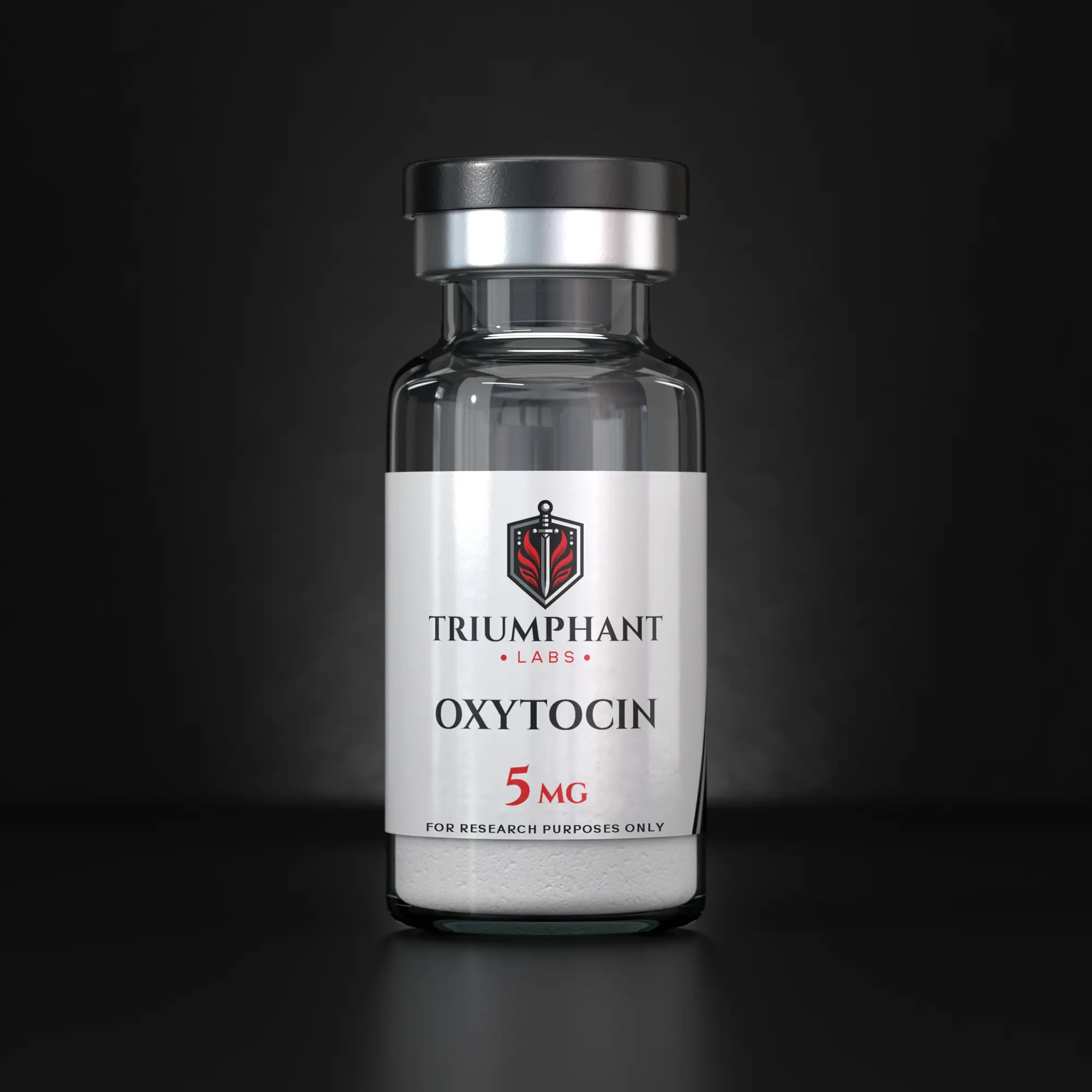
Oxytocin 5mg
$43.00
Oxytocin is a naturally occurring neuropeptide and hormone with one of the most extensively studied and biologically diverse research profiles in neuroscience and endocrinology. This 5mg research-grade formulation has attracted sustained scientific interest among researchers exploring social behavior, bonding biology, stress response, pain modulation, and the broader landscape of neuropeptide-mediated central nervous system function.
Oxytocin is a nine amino acid neuropeptide produced in the hypothalamus and released by the posterior pituitary gland, with a biological profile that spans both peripheral hormonal function and central neurotransmission. First characterized in the early twentieth century for its roles in uterine contraction and lactation, oxytocin has since emerged as one of the most multifaceted and scientifically compelling signaling molecules in human biology.
Decades of research have progressively revealed its involvement in social cognition, emotional bonding, stress regulation, pain modulation, and metabolic function, establishing it as a neuropeptide of exceptional breadth and biological significance that continues to generate active scientific investigation across multiple disciplines.
Research Interests and Potential Applications
Oxytocin has developed one of the most diverse and well-referenced research profiles of any neuropeptide, with scientific investigation spanning an unusually broad range of biological and behavioral domains including:
Social behavior and bonding biology, the area most closely associated with oxytocin in the popular and scientific imagination, where research has examined its role in facilitating trust, social recognition, pair bonding, and affiliative behavior through central nervous system receptor activation.
Stress response and anxiety modulation, with studies exploring how oxytocin signaling in the hypothalamic-pituitary-adrenal axis and limbic system influences cortisol release, fear responses, and the physiological and behavioral dimensions of stress resilience. Pain modulation and analgesic research, an area of growing scientific interest where oxytocin receptor activation in the spinal cord and brain has been studied for its proposed influence on pain perception and central pain processing pathways.
Autism spectrum and social cognition research, a clinically motivated area of investigation where oxytocin’s role in social information processing has prompted extensive study into its potential relevance to conditions characterized by social communication differences. Metabolic and appetite regulation, an emerging research frontier where oxytocin receptor signaling in the hypothalamus and brainstem has been linked to food intake behavior, energy balance, and potential interactions with the broader hormonal network governing metabolic homeostasis.
Mechanism and Commonly Discussed Function
Oxytocin exerts its biological effects through binding to the oxytocin receptor, a G-protein coupled receptor expressed in a wide range of tissues including the uterus, mammary glands, heart, kidneys, and extensively throughout the central nervous system. In the brain, oxytocin receptor expression is particularly dense in regions associated with social behavior, emotional processing, and stress regulation, including the amygdala, hippocampus, nucleus accumbens, and hypothalamus. Receptor activation in these regions is understood to modulate neuronal excitability and neurotransmitter release in ways that collectively shape social cognition, emotional responses, and stress reactivity.
A particularly important aspect of oxytocin biology is the distinction between its peripheral hormonal functions and its central neuromodulatory roles. As a peripheral hormone, oxytocin coordinates uterine contraction during labor, facilitates milk ejection during lactation, and contributes to cardiovascular regulation. As a central neuromodulator, it participates in the fine-tuning of social and emotional brain circuits through mechanisms that remain an active area of neuroscientific investigation. The interaction between peripherally and centrally released oxytocin, and the conditions under which each pool is activated, represents a nuanced and scientifically important research question.
Research has also identified oxytocin’s proposed interactions with the dopaminergic reward system and the serotonergic system, suggesting that its influence on social behavior and emotional wellbeing may be mediated in part through modulation of these well-characterized neurotransmitter networks. These cross-system interactions add considerable complexity and scientific depth to oxytocin’s research profile.
Why the Research and Wellness Community Is Interested
Oxytocin occupies a unique position in the scientific landscape as a molecule that bridges hard neuroscience and the biology of human social experience. Its documented roles in bonding, trust, stress resilience, and social cognition have made it a subject of intense interest not only in basic neuroscience but in psychiatry, behavioral science, and translational medicine research. The breadth of biological systems it touches, from the hypothalamic-pituitary axis to the limbic system to peripheral reproductive and metabolic tissues, reflects its status as a genuinely integrative signaling molecule.
Within advanced wellness communities, oxytocin has attracted interest as a naturally occurring neuropeptide with documented associations with emotional wellbeing, stress management, and social connection, areas of growing relevance in contemporary discussions of mental health, resilience, and holistic biological optimization. Its natural origin, well-characterized receptor biology, and decades of rigorous scientific investigation have made it a consistently compelling subject for researchers and wellness professionals exploring the neurobiology of human experience.
Product Quality and Formulation
This oxytocin is produced to research-grade standards with verified nonapeptide sequence fidelity, confirmed disulfide bridge integrity, rigorous purity assessment, and consistent potency per 5mg vial. The cyclic structure of oxytocin, maintained by a critical disulfide bond between cysteine residues, is essential to its receptor binding activity, and synthesis precision at every stage of production is prioritized to ensure structural integrity and consistent biological performance. Researchers can rely on a well-characterized compound suitable for demanding and reproducible scientific investigation.
Oxytocin remains one of the most scientifically significant and broadly studied neuropeptides available for research today. For scientists and advanced wellness professionals exploring social neuroscience, stress biology, pain modulation, emotional processing, and the broader landscape of neuropeptide-mediated central nervous system function, this formulation provides a premium and dependable foundation for serious and meaningful scientific investigation.
Be the first to review “Oxytocin 5mg”
Related products

Reviews
There are no reviews yet.